

Stop Trying to Solve Everything in One Workshop
5 lessons from Tim Leake on designing high-ROI sessions

Ever tried to solve everything in one workshop?
If you’ve been in a session where 10 priorities get stuffed into a 6-hour agenda… you know how that ends…
Not much gets solved.
Yes, maybe more than in a regular meeting, but still not enough.
Why?
Because people don’t get the time to fully understand the challenge, connect with it, and then actually solve it.
In one of the latest Another Day, Another Workshop podcast episodes, I spoke with Tim Leake, an amazing facilitator with a background in creative advertising who’s been working with exec teams for 15+ years.
We talked about what it really takes to design a high-ROI workshop, the kind that creates real business results.
And let’s be real: in today’s economy, leaders only invest in what moves the needle. These tips can help you win those deals and justify your rates.
Here are my 5 favorite takeaways from the conversation 👇
1. Stop solving symptoms. Find the MVC.

Most workshops start from a long list of issues.
Tim flips that: he looks for the Most Valuable Challenge (MVC).
That’s the one challenge that:
Solves a real, critical problem
Unlocks momentum in the org
Is worth real time and resources
Try solving five things at once and you’ll solve none.
Focus on the right one and that’s where ROI kicks in.
Tim sometimes even runs a pre-workshop just to align on the MVC.
MVC Example: doubling profit margin = $30M impact.
2. Use the value score to prioritize like a pro

How do you know which challenge is the MVC?
Tim doesn’t rely on vibes or voting dots to pick the MVC.
He uses a three-part value score to help teams prioritize challenges through three lenses:
Emotional Value
How much energy, excitement, or cultural benefit do we get from solving this?
Ecosystem Impact
Does solving this create ripple effects? Will it unlock or fix other problems too?
Monetary Value
What’s the estimated financial impact of solving this over the next 3 years?
I loved one of his lines to execs: “Let’s assume an 80% failure rate. Even if we only solve 20%, that’s still $6M.”
That changes the conversation, and makes it much easier to negotiate more time.
3. Don’t overthink it. Don’t underthink it. Optimally think it.
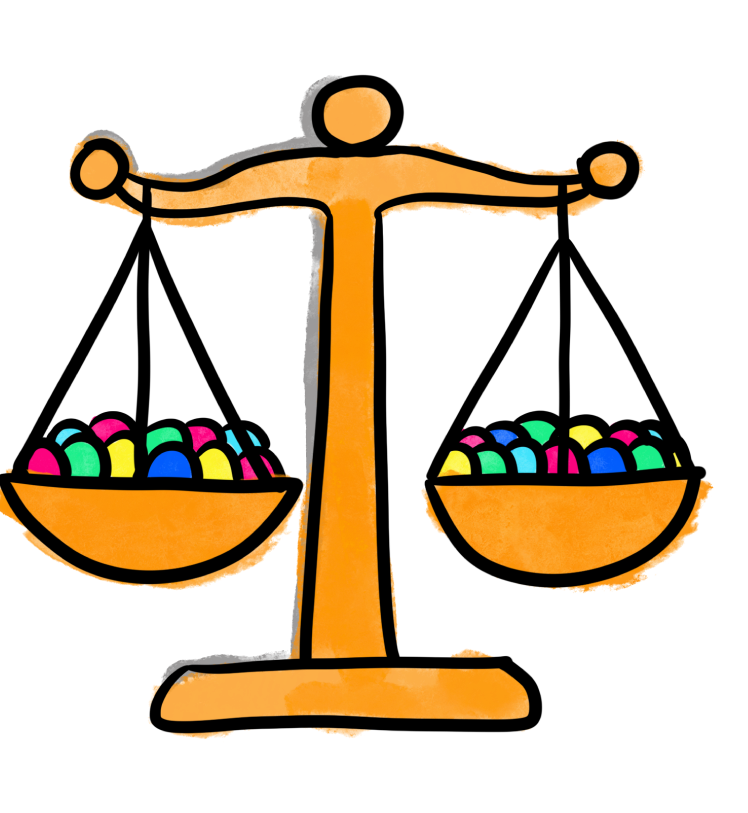
This is one of Tim’s favorite concepts, and it really stuck with me.
Business culture is full of overthinking.
Workshops often suffer from underthinking.
We either spend months circling around a problem…
Or we rush through it in a 90-minute session full of sticky notes and surface-level ideas.
But a good workshop creates space for optimal thinking: time-boxed, structured, deep enough to solve without getting stuck in perfectionism.
And yes, that sometimes means pushing back when a client says, “You only have three hours with the leadership team.”
Because if the challenge is worth €30M, we need more than an icebreaker and a brainstorm.
4. Replace your action plan with an alignment plan
Here’s something most facilitators learn the hard way:
Even if the workshop goes brilliantly, things fall apart if the rest of the org isn’t on board.
That’s why Tim swaps the usual “next steps” exercise for something bigger: an alignment plan. And it’s not a quick 30-minute wrap-up. In his high-ROI workshop recipe, alignment takes up a full 40% of the session.
Here’s what the alignment plan includes:
A strategy to communicate the “why” behind the challenge
A way to tell the story of the solution (not just what, but how and why)
Real tools for buy-in: slides, videos, follow-up workshops, messaging
Time during the workshop to actually build those things (not defer them)
Tim shared a powerful example where, instead of ending with a bullet-point plan, the leadership team used the last stretch of the workshop to script and record internal videos and plan 90-minute rollout workshops for the rest of the org.
Not just ideas, outputs.
5. Facilitation lives between improv and stand-up.
In a fun detour, we explored how facilitation borrows from both improv and stand-up comedy.
Improv teaches us to trust the moment, adapt, and co-create with others.
Stand-up teaches us to sharpen our message, read the room, and land the punchline.
Great facilitators do both designing strong structures, then letting go and dancing with the group.
Enjoyed these takeaways?

If you liked this recap, go listen to the full episode, it’s packed with facilitation wisdom, creative analogies, and practical strategies.
Spotify :
Apple Podcast :
A new episode drops every two weeks, so stay tuned!
And if you liked it, leaving a thumbs-up or 5-star rating would mean a lot. 🙏
One last thing, I’m finally launching the Workshop Deck
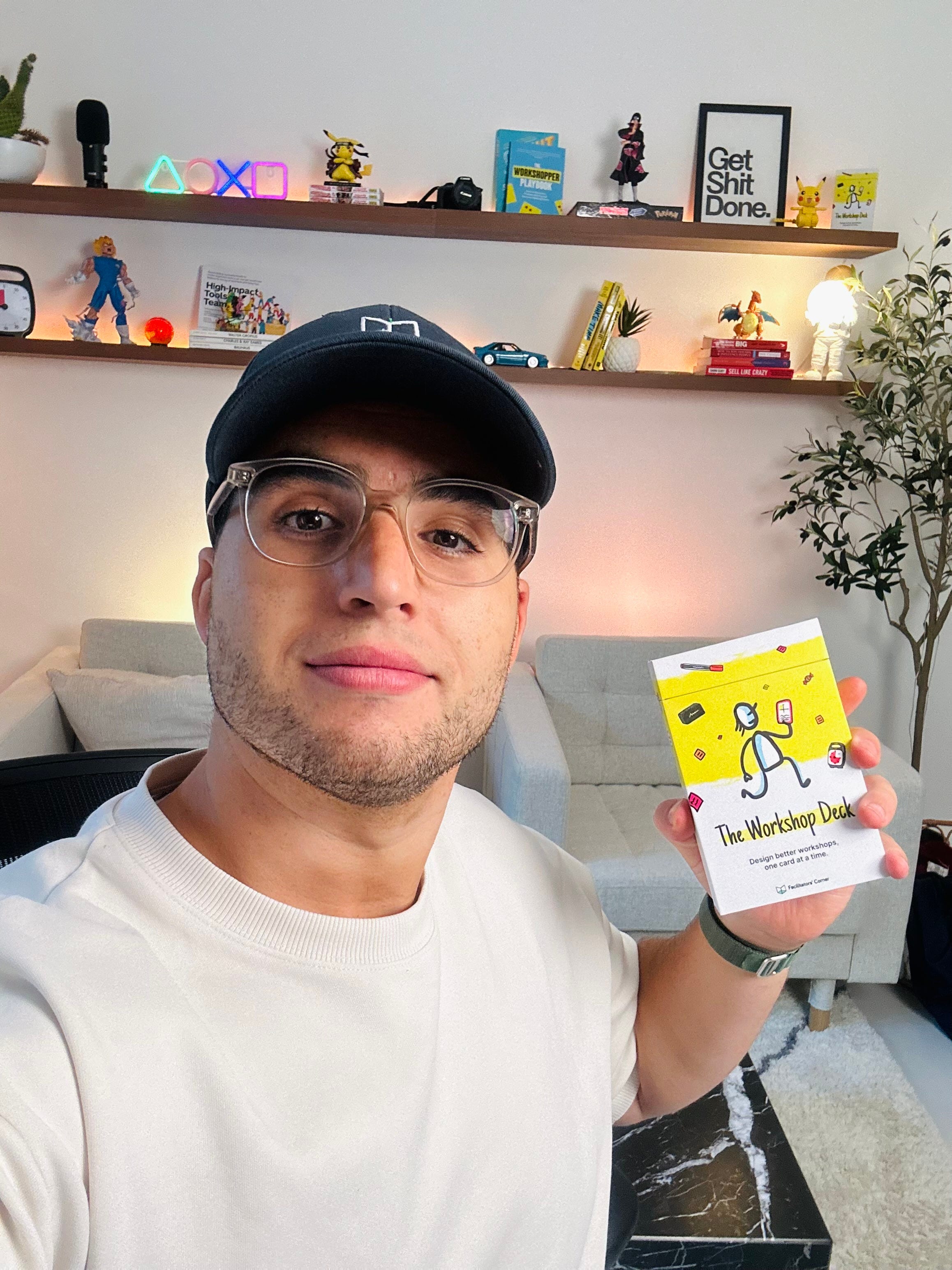
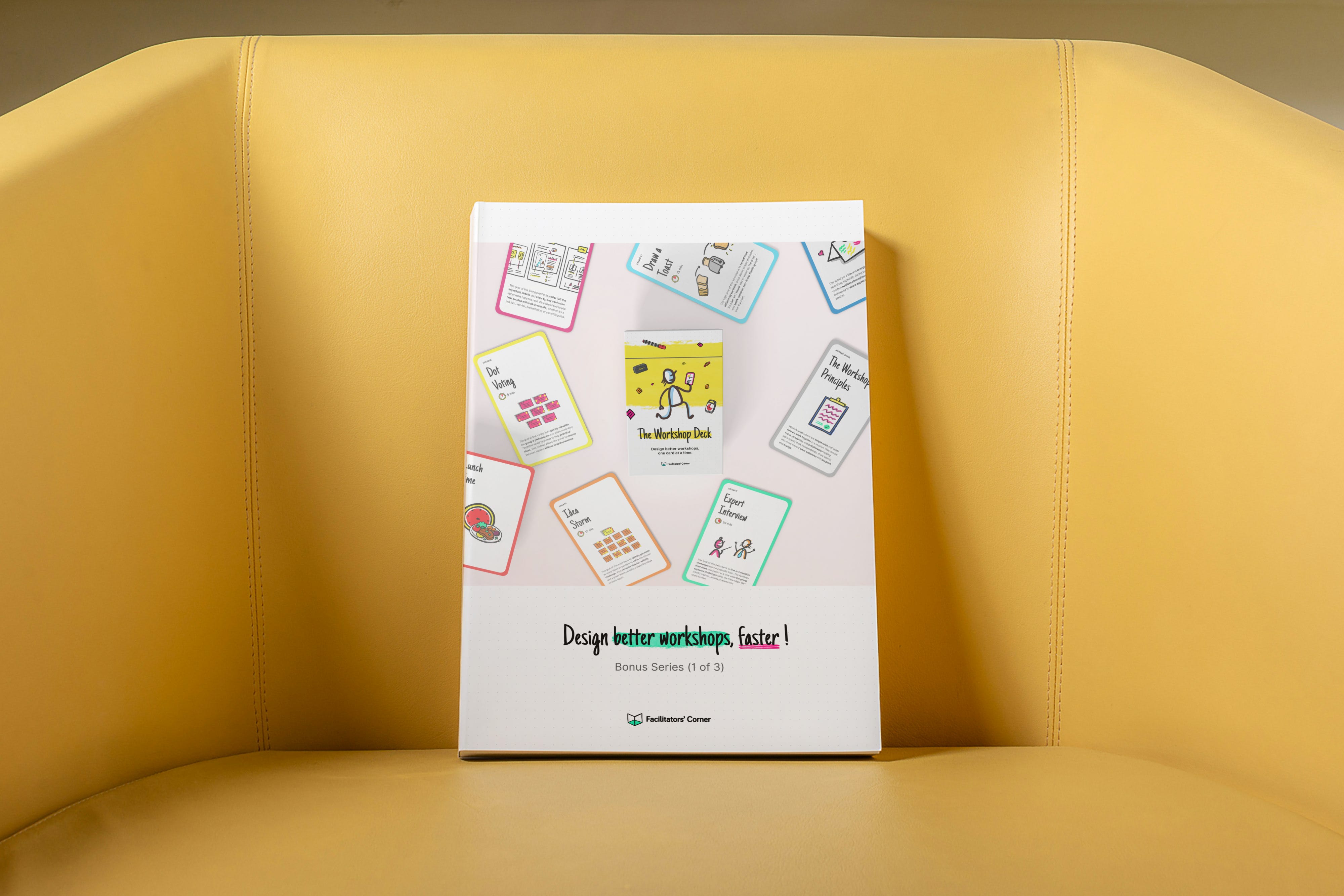
The Workshop Deck is a set of cards that helps consultants, leaders and facilitators design impactful workshops in less time.
It’s built on a simple but powerful method called the 6C Framework. Each card is color-coded to one of the six phases, making it super easy to put together a workshop that flows smoothly from start to finish.
Want to try it out?
Join the waitlist to get early access
Not ready for all the bonuses in your inbox? No worries
You can grab the first bonus here, the download starts in 5 seconds, no email required, just a bit of patience.
Oh, and one more thing…
I’m cooking up something very special:
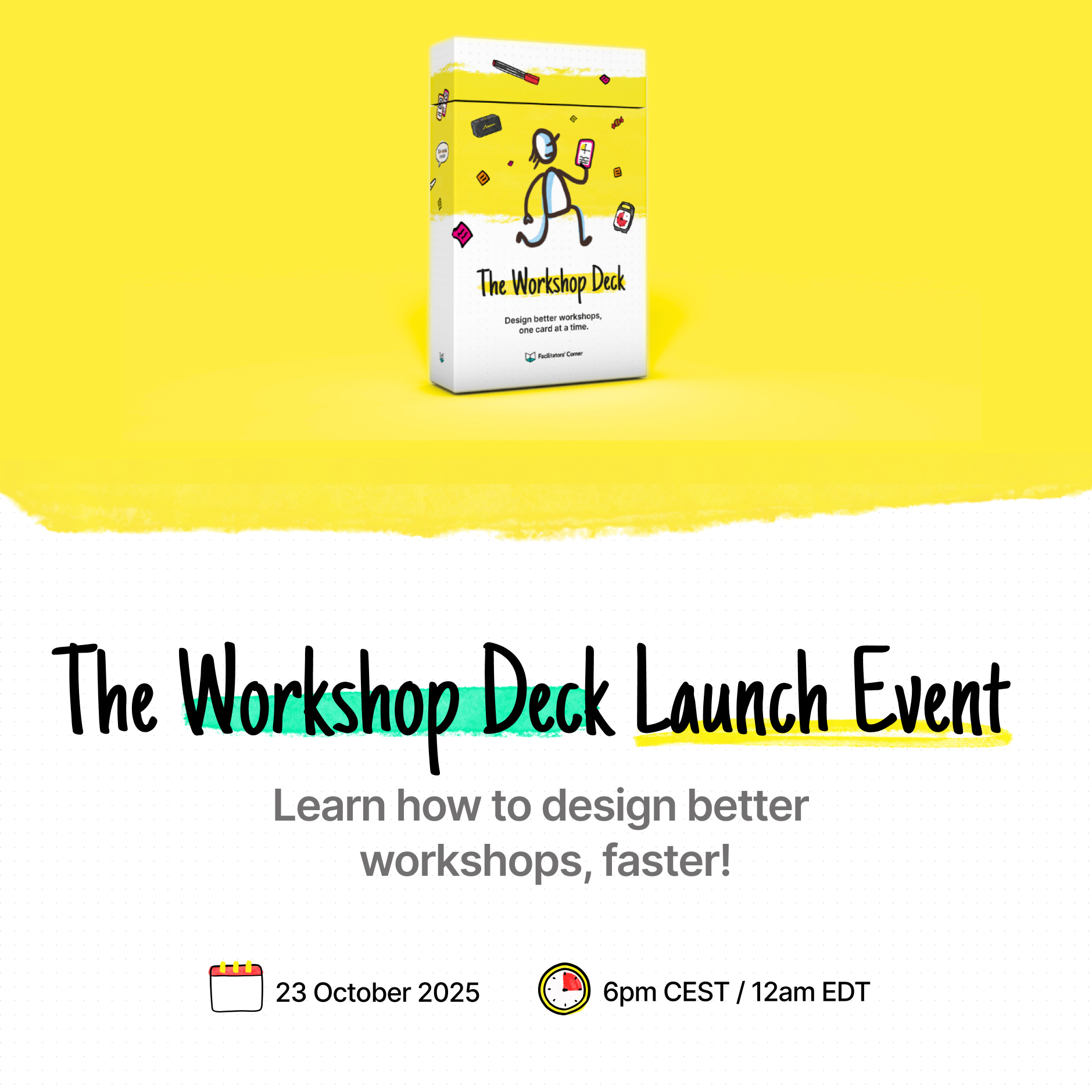
A free live launch event on: October 23 at 6PM CET / 12 PM EDT
It’s going to be packed with insights, surprises, and giveaways.
Here’s what’s waiting for you:
A free live training on how to design better workshops
A first look at a secret project I’ve been working on (I really think it could change how you design workshops)
A special gift worth €299, free for everyone who joins live
Exclusive launch deals and bonuses that won’t be available afterward
Don’t miss this one, it’s going to be fun 🎉
Re. Lessons #1 and #4, because of the linear nature of most collaborative content such as slides, docs, videos or messaging, the cause-effect relationships between each piece of thought that is shared, rarely emerge and are therefore, seldom discussed.
Follow-up workshops will typically generate even more linear content, without drawing explicit, visual causality onto which everyone could have agreed and aligned.
To help achieve such level of collective outcome, a practice known as Visual Thinking is a dimension of workshop facilitation which builds on the shoulders of Graphic facilitation (in more concrete ways), Mind mapping (in more meaningful ways) and Logical thinking (to bring water-tight logic to the spontaneous flow of emotion, logic and intuition):
https://youtu.be/WeHVws6gxlc
I love the lively tone of your production. You're an amazing host and with Tim LEAKE, you've got an incredible guest to match!
Lesson #5 re. Improv/Stand Up is perhaps the most powerful if we take the time to digest this essential quote:
"Stand-up teaches us to sharpen our message, read the room, and land the punchline."
Thank You Mehdi! You rock!