

The strategy workshop mistake almost everyone makes
A six-question framework to build strategies that actually get implemented

Most strategy workshops produce the same thing.
A bold vision statement. Ambitious business goals. A nice slide deck that pleases management.
And six months later, nothing has moved…
The strategy deck is collecting dust somewhere in a digital folder.
Here’s the uncomfortable truth: the problem isn’t execution. It’s that the strategy was never built on solid ground in the first place.
I’ve run strategy sessions for Novartis, Volvo, Toyota. And for a long time, I kept seeing the same pattern: great energy in the room, weak results six months later.
So I built my own answer to that problem. I call it the Strategy Arc, six questions I now run every strategy workshop through, in order.
Two of them, almost everyone skips. And those two are exactly why most strategies end up unrealistic and useless.
The Strategy Arc
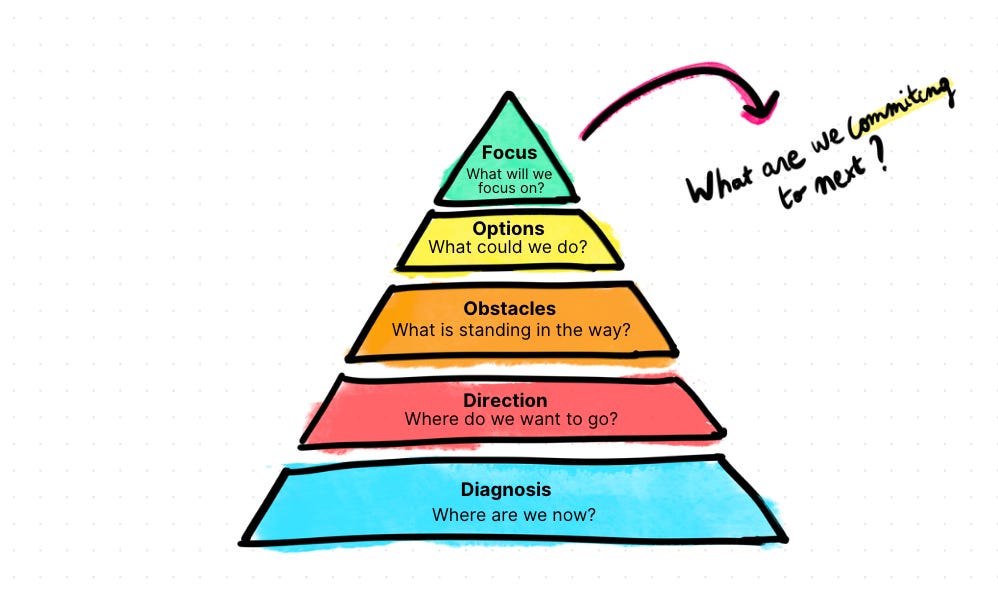
1. Where are we now? (Diagnosis)

This is the one that gets skipped the most. Teams are so eager to define where they want to go, they forget to be honest about where they’re standing.
Before you define an ambitious direction, you need to assess where you are today. Otherwise you’ll end up with big numbers and bold statements that have no grounding in reality. A good strategy acknowledges the current situation and uses it to shape a realistic direction.
It doesn’t mean you can’t be ambitious. But if you’ve never grown more than 10%, going for 200% is a stretch, and it needs to come with clear levers to actually get there.
Two activities I use here: the Sailboat (what’s working, what’s not) for shorter sessions, and a SWOT analysis when we have more time and need to factor in market context.
2. Where do we want to go? (Direction)
This is the one everyone is excited about.
The direction can take many forms, such as:
Business goals : What do we want to achieve ?
A vision : Who do we want to be in the future ?
A purpose : Why do we exist ? What purpose do we serve ?
Not everyone in the room has written a vision statement before, or spent time thinking about purpose. So keep your activities simple to explain and give people enough guidance to actually contribute.
Two pieces of advice when facilitating this step.
First, give them a specific starting point. If you’re working on purpose, ask everyone to start with “We exist to...” It removes the blank page effect and makes it easier to compare ideas across the group.
Second, bring concrete examples. Show them what good looks like. A company like Amazon: “We exist to connect people with the right product they need at the lowest price.”
Real examples help participants visualize what you’re asking for, and they tend to unlock much better contributions.
3. What is standing in the way? (Obstacles)

This is the second most skipped question. And it’s a shame, because this is where a good strategy separates itself from a wish list.
You have a diagnosis and a direction. Now it’s time to define how you’re going to get there. And the first step is to identify what could stop you.
It’s only by surfacing those obstacles and understanding them that you can build a plan to actually deal with them. Richard Rumelt, whose book Good Strategy Bad Strategy genuinely changed how I think about this, makes exactly that point: a good strategy is not just a direction, it’s a response to the specific challenges standing between you and that direction.
So how do you do this in a workshop? Simple. Ask participants to brainstorm the obstacles. A method I love is to have them formulate each obstacle as a question, starting with “Can we...” For example: “Can we build a high-performing mobile app with our current IT legacy?” or “Can we retain our best people while going through this change?”
Quantity over quality. Get it all out. Then prioritize.
4. What options do we have? (Ideation)

We now have all the ingredients for a real strategy, except the most critical one: how do we actually get there?
It’s time to brainstorm actions.
Before generating ideas, invite participants to go back through everything: the diagnosis, the direction, the prioritized obstacles. Keep it all fresh in the room. Then ask them to come up with options that take all of it into account.
This is what separates useful ideas from wishful ones. If your diagnosis showed you’ve always struggled with follow-through, you don’t put “follow up on every customer complaint” on the list without also designing the system that makes it possible.
The previous steps exist for this moment. Use them.
5. What will we focus on? (Prioritization)

Resources are limited. You cannot do everything. This is the moment teams hate most, because choosing means saying no.
The key here is to build their confidence to make the decision. If you just ask people to pick their favourites, you’ll get biased choices driven by gut feel, politics, or whoever spoke loudest in the room.
This is why I use a multi-layer approach. A few voting rounds, each one removing a different bias. Dot voting first to get a quick read on the group. Then a role-based vote, where each person votes as their function, not just as an individual. Then an impact/effort matrix to bring some objectivity in.
The sequence matters. Each step makes the next decision easier and more defensible. By the end, people feel confident about what they chose. They’re not guessing.
The exact sequence can vary. What matters is the principle: don’t ask people to make one big scary decision. Walk them there step by step.
6. What are we committing to next? (Commitment)
The final step is turning prioritized ideas into owned, timed, tangible actions. Who is responsible? By when? How will we know it worked?
This is what determines whether the strategy sees the light of day, or lives forever on a slide deck in a shared Teams drive. Yes, the same one collecting dust. 😄
That was the Strategy Arc..
Six questions. In the right order. Spend time on all of them and your strategy will be stronger, more realistic, and actually drive change.
But don’t forget the two that get skipped. Every time.
Diagnosis and obstacles.
The diagnosis forces you to be honest about your limitations, and more aware of the strengths you can leverage.
The obstacle brainstorm forces you to imagine failure before you’ve even started, and to come up with tactics to prevent or overcome them.
Skipping them is exactly what produces the fluffy, unimplementable strategies Rumelt was writing about. Goals without grounding. Direction without a plan to actually get there.
Do the uncomfortable parts. That’s where the strategy actually happens.
If you enjoyed this, you’ll love the full episode. I go deeper into each question, share the activities I use, and show examples from real sessions. Watch it on YouTube, or catch it on Spotify:
and Apple Podcasts:
Before you go, three free facilitation trainings coming up
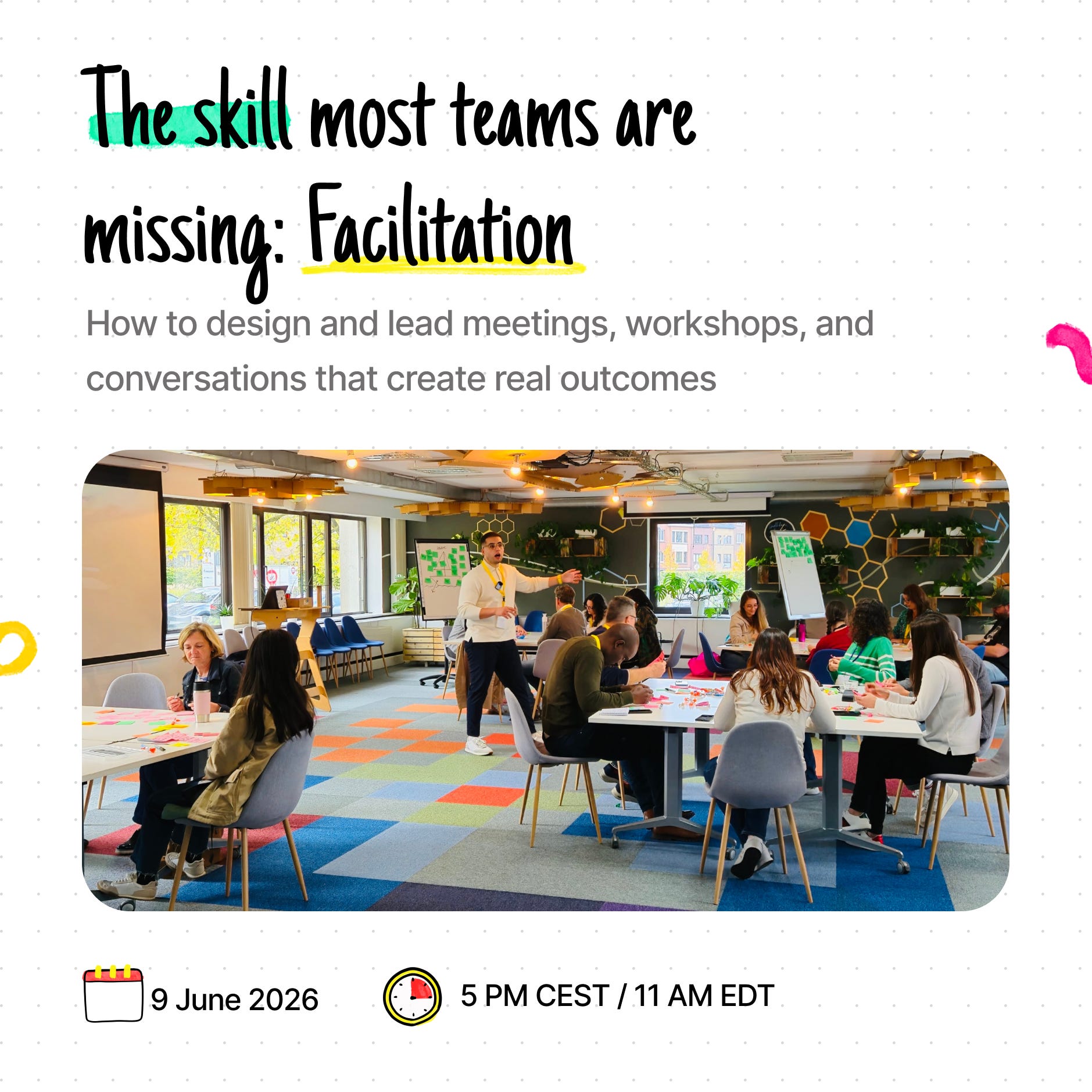
On June 9th, I’m running a free 90-minute live training from 5:00 to 6:30 pm CET.
I’ll share my system to design and deliver workshops that actually get results. We’ll cover:
Why facilitation is becoming an essential skill for leaders, consultants, project managers, and team leads
Why so many meetings and workshops feel slow, confusing, or ineffective
How to structure a workshop from ideas to alignment to decisions
How to ensure the right flow to get real outcomes by the end
Free. Live. And I'll stay as long as it takes to cover all your questions.
After the workshop: How to ensure real change
Most facilitators focus on getting the session right.
But very few design for what happens afterwards. When the workshop is over. When the energy drops. When you’re no longer there to guide the group.
And yet, that’s where real change happens.
This is the topic I’m bringing to SOFest in the UK next month, an award-winning learning facilitation festival, an event unlike any other. But before I take it there, I’m running a free version of it inside the fit for facilitation community.
Two reasons. First, I think you’ll genuinely learn something useful: my tactics to make sure momentum carries through after the room empties.
Second, honestly, I want to test my story before the big stage. So you’ll be helping me make sure the keynote really lands.
Come for the insights. Stay to help me stress-test it. 😄
Stormz is launching, and you want to be there
Alexandre Eisenchteter, co-founder of Fit For Facilitation and creator of Stormz, is launching the new version of his tool this month. And I can only say one thing: this is going to be remarkable.
I’ve seen the behind-the-scenes. I’m actually using it in my own sessions this Tuesday. And I already know it’s going to become a staple in my online and in-person work.
Stormz is not another whiteboard. It helps facilitators turn questions into live group experiences. People answer, react, vote, and contribute easily. You can then reveal patterns, focus attention, create memorable moments, and guide the group forward through a simple flow: Ask. Collect. Pick. Debrief.
In this live session, Alex will show you exactly how it works and how it can help you run more creative, more effective sessions, whether you’re remote, in-person, or both.
Everyone who attends live will receive a private invitation to try Stormz before wider access opens.
Okay, that was a long one. Hope you enjoyed it.
See you at one of these events. Take care.
See you in the corner. 💚
Mehdi
Love this piece Mehdi! The part about setting a vision statement of "we exist to" is so critical to get people on the same page or hearing their peers' goals. Something I use in my strategy workshops to turn pain points & problems into action and get to tangible solutions is to use the "How Might We" activity. Take the big list of challenges, goals, pain points, etc. and turn each of them into a "how might we" statement.
For example, if the challenge is that customers churn because they're getting passed off from one person to the next on a support call, then the statement might be "how might we create a system that gets our customers the support they need quickly?"
I like this as a transition into getting from challenge/goal identification into action-oriented solutioning.